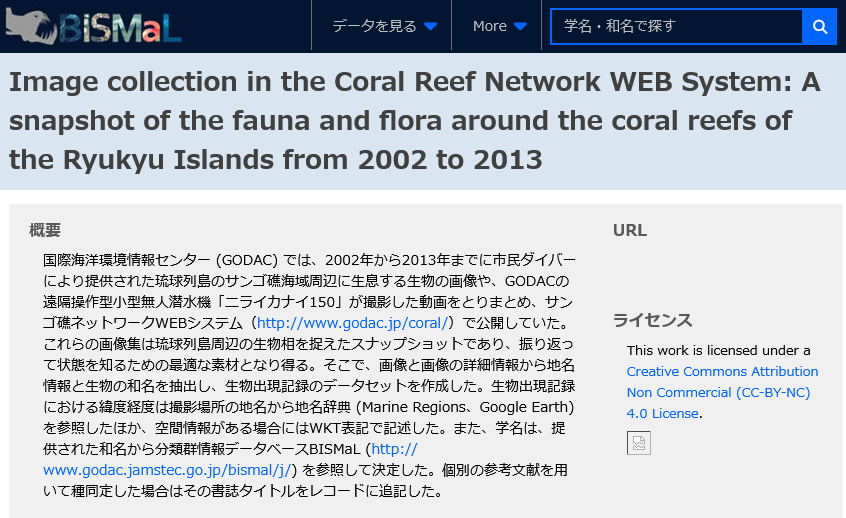
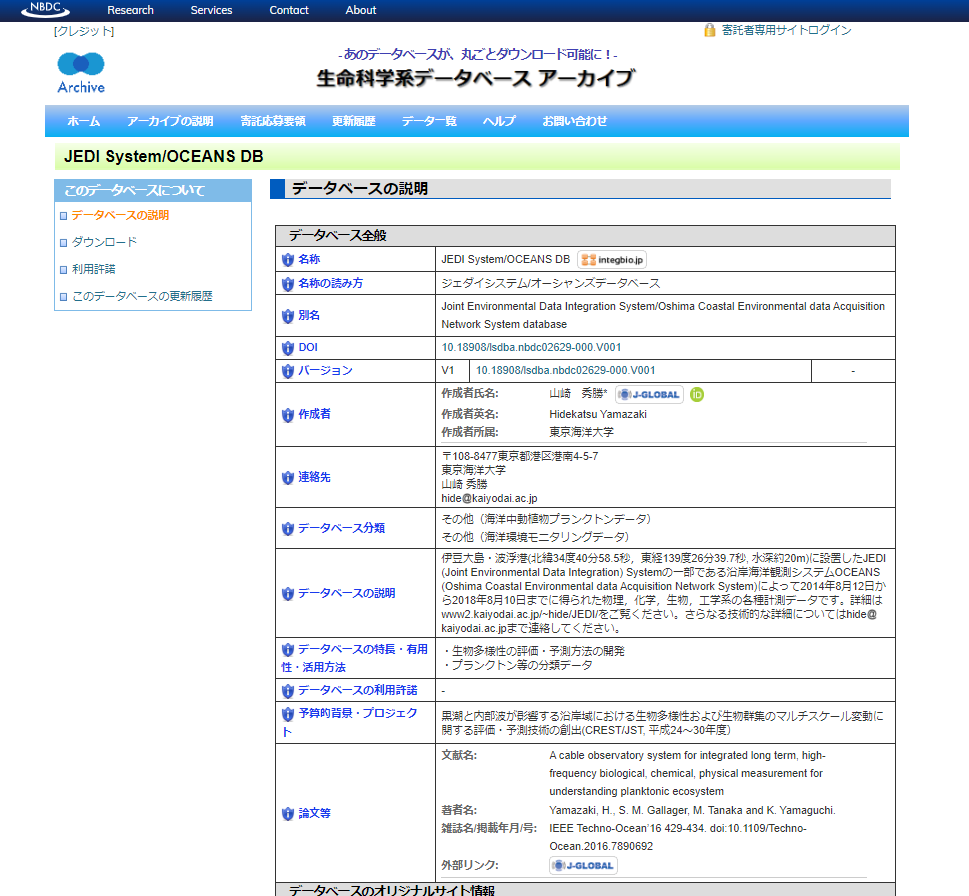
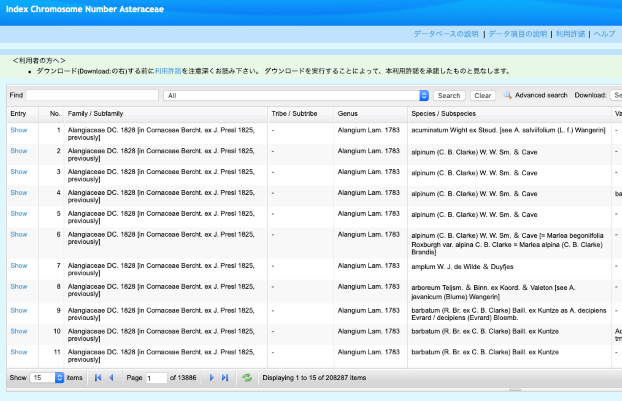
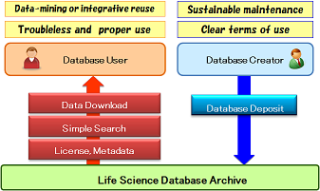
If a database is inadequate in terms of its description, unclear with respect to the terms of use, or is not downloadable, it may not be fully used, cited or rightly acknowledged by the (research) communities. This is even true for databases with high-quality datasets.
The Life Science Database Archive maintains and stores the datasets generated by life scientists in Japan in a long-term and stable state as national public goods. The Archive makes it easier for many people to search datasets by metadata (description of datasets) in a unified format, and to access and download the datasets with clear terms of use (see here for detailed descriptions).
In addition, the Archive provides datasets in forms friendly to different types of users in public and private institutions, and thereby supports further contribution of each research to life science.
| Database name | Maintenance site | Principal creator | Database classification | Organism | Summary | License | |
|---|---|---|---|---|---|---|---|
| Society Catalog |
National Bioscience Database Center ![]() |
Shoko Kawamoto | Catalog | - | The database of information of the academic societies in Japan (organization name, website URL, contact address, etc.) | CC BY-SA Detail |
|
| tRNADB-CE |
Nagahama Institute of Bio-Science and Technology![]() |
Takashi Abe | RNA sequences | prokaryotes | The most accurate curated database of tRNA genes in the world. Data is reviewed by several experts. | CC BY-SA Detail |
|
| Open TG-GATEs Pathological Image Database |
National Institute of Biomedical Innovation ![]() |
Toxicogenomics Project / Toxicogenomics Informatics Project | Toxicogenomics database | rat | The database of high-resolution whole slide digital pathological images of liver and kidney pathological specimens which were obtained through animal tests using 160 compounds. | CC BY-SA Detail |
|
| Open TG-GATEs |
National Institute of Biomedical Innovation ![]() |
Toxicogenomics Project / Toxicogenomics Informatics Project | Toxicogenomics database | human, rat | The database of gene expression and toxicity when exposing rats and rat and human liver cells to 170 compounds. | CC BY-SA Detail |
|
| ClEST |
Symbiotic Evolution and Biological Functions Research Group, Bioproduction Research Institute, National Institute of Advanced Industrial Science and Technology (AIST) ![]() |
Minoru Moriyama | cDNA | bedbug | The database of expressed sequence tags (EST) of unique organs and whole bodies of the bedbug, Cimex lectularius. | CC BY-SA Detail |
|
| DGBY |
National Food Research Institute, National Agriculture and Food Research Organization (NARO) ![]() |
Akira Ando | Expression | Yeast | This database compiles the transcriptomics and phenomics data about the stress tolerance of baker's yeast. | CC BY-SA Detail |
|
| D-HaploDB |
Division of Genome Analysis, Research Center for Genetic Information, Medical Institute of Bioregulation, Kyushu University ![]() |
Kenshi Hayashi | Polymorphism | human | This database presents true haplotypes and LD structures of Japanese genome, determined using DNA samples obtained from complete hydatidiform moles. | CC BY-SA Detail |
|
| Plabrain DB |
Laboratory for Molecular Developmental Biology Department of Biophysics, Division of Biological Sciences, Graduate School of Science, Kyoto University ![]() |
Kiyokazu Agata | Expression, Localization | planaria | The database for planarian nervous system analysis, including results of the gene expression profiling of single cells, the gene expression analysis by whole-mount in situ hybridization and the analysis by Immunohistochemical staining. | CC BY-SA Detail |
|
| GETDB - Gal4 Enhancer Trap Insertion Database |
Kyoto Institute of Technology![]() |
Shigeo Hayashi | Expression | fruit fly | The database compiles insertion points of Gal4 enhancer trap and patterns of enhancer activity in fruit fly. | CC BY-SA Detail |
|
| AcEST |
Tokyo Metropolitan University![]() |
Takeshi Kanegae | cDNA | fern | The database of Adiantum capillus-veneris EST clones and annotations of them. | CC BY-SA Detail |
|
| Dicty_cDB |
University of Tsukuba![]() |
Hideko Urushihara | cDNA | cellular slime mold | The database of Dictyostelium discoideum cDNA sequences and annotations (results of blast search, motif search, prediction of product localization, expression profile, alignment to the genome, and so on) | CC BY-SA Detail |
|
| Gclust Server |
The University of Tokyo![]() |
Naoki Sato | Protein sequences | 95 species | The database of protein sequence clusters in 95 species. They are obtained from the comparison of all-against-all blast search results. | CC BY-SA Detail |
|
| Budding yeast cDNA sequencing project |
The University of Tokyo![]() |
Takashi Ito | Genome (non-vertebrate) - Fungal genome | budding yeast | The database of budding yeast 5'cDNA full length clones. | CC BY-SA Detail |
|
| Yeast Interacting Proteins Database |
The University of Tokyo![]() |
Takashi Ito | Protein-protein interactions | budding yeast | The database of budding yeast protein-protein interactions obtained from Y2H. | CC BY-SA Detail |
|
| DMPD (Dynamic Macrophage Pathway CSML Database |
The University of Tokyo![]() |
Satoru Miyano | Metabolic and Signaling Pathways | mammals | The database of pathways associated with differentiation and activation of macrophage. | CC BY-SA Detail |
|
| BodyParts3D |
Database Center for Life Science![]() |
Kousaku Okubo | organ | human | The dictionary-type database for anatomy in which anatomical concepts are represented by 3D structure data that specify corresponding segments of a three-dimensional whole-body model for an adult human male. | CC BY-SA Detail |
|
Database Center for Life Science![]() |
Kousaku Okubo | Dictionary | 9 species (human, mouse, rat, zebrafish, fruit fly, nematode, budding yeast, fission yeast, Bacillus subtilis) | Gene names and gene family names were collected for 9 different organisms (including human, mouse, rat, zebrafish, fruit fly, nematode, budding yeast, fission yeast, Bacillus subtilis), and associated with parallel relationship (synonym) and hierarchical relationship (family name). Acronym notations and IDs of typical gene/genome databases are also treated as names. | CC BY-SA Detail |